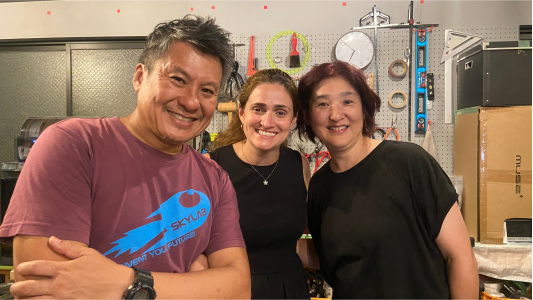
Between cultures, people, and learning: reflections from a journey through Japan and the United States
As part of her fellowship experience, Graziella Matarazzo traveled to Japan and the United States to explore how different cultures approach learning, creativity, and digital fabrication. What she encountered went far beyond tools or technologies. Through conversations with educators, families, and students, she observed how values, traditions, and community shape the conditions for meaningful learning. In the reflection that follows, Graziella shares the insights, contrasts, and questions that emerged from her time in Osaka, Tokyo, Kamakura, and Cleveland and how these experiences continue to influence her work in STEM education and digital fabrication.
Lessons by Graziella Martarazzo:
1.) Creatures from the Island of Corso 3.0
Students engage in an open-ended process that blends art, engineering, and technology. Using simple materials and, when available, FabLab resources such as pre-made 3D parts, laser-cut elements, vinyl, and basic electronics, learners bring their creatures to life through physical models and storytelling.
Between cultures, people, and learning: reflections from a journey through Japan and the United States
Traveling through a STEM fellowship is not merely about visiting labs, schools, or new technologies. Above all, it is an exercise in listening, listening to people, to places, to cultures, and, inevitably, to oneself.
I was selected for the Chevron STEM Fellowship, organized by the Fab Foundation, from approximately 60 applications worldwide. Three women were chosen: one from Brazil (me), one from Vietnam, and one from Colombia. That fact alone carries meaning. Women occupying spaces of digital fabrication, education, and social impact. Women in motion.
As part of the fellowship, I was invited to experience Fab Labs and educational environments both outside and within the United States. My choices were intentional.
In Japan, I spent time in Osaka, Tokyo and later traveled to Kamakura, where I worked closely with Skylab. In the United States, I visited Cleveland, Ohio, engaging with public and private schools, innovation programs, and learning spaces connected to science, engineering, and fabrication. What I encountered in these two countries went far beyond machines, Fab Labs, or well-designed projects. I encountered different ways of being in the world, and those differences deeply shape how learning happens.
In Japan, one of the most powerful takeaways was the value placed on the ordinary. What is often described as a Zen way of life is not about extraordinary achievements, but about the quality of presence in each moment. In conversations with locals, I heard repeatedly that every encounter is unique. Even if you say the same words every day, it is never the same
day, never the same person on the other side. This perspective quietly reshaped how I think about education, time, and attention. In Osaka, visiting the Expo 2025 site, I was struck by the decision to build a monumental structure entirely out of wood, using traditional Japanese joinery techniques without nails or screws. Technology there was not about excess or spectacle; it was about accumulated knowledge, sustainability, and respect for cultural
heritage. At the Women’s Pavilion, these ideas connected naturally to global conversations about equity, inclusion, and the future.
Back in Tokyo, I experienced the immersive world of TeamLab Planets, where art, technology, and participation merge seamlessly. Children and adults draw, move, and become part of the artwork itself. Yet one of the most meaningful moments of the trip did not come from advanced digital systems. It came from a small handmade paper workshop, where an elderly man worked slowly and manually, with precision and care. That experience reminded me that innovation does not depend solely on digital tools, but on intention, craftsmanship, and human presence.
This same philosophy surfaced during my visit to Fuji Kindergarten. A circular school where children play freely on the rooftop, connected to nature and trusted with real autonomy. There is structure, yes — but it is a structure designed to support freedom. The Montessori principle, “help me do it by myself,” is not a slogan there. It is lived practice.
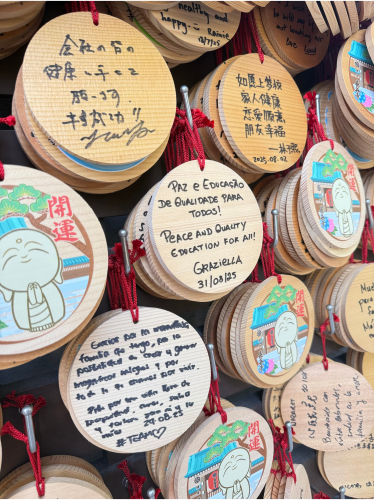 This care for time, body, and mind appears in the details: in temples where messages are left with intention, in architecture that makes room for silence, in the appreciation of simplicity. In Kamakura, I left my own message: peace and quality education for all, not as a distant hope, but as a commitment.
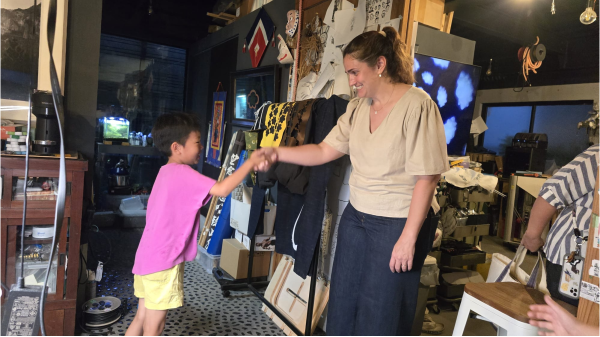
My time in Kamakura became one of the most meaningful parts of the journey. At Skylab, I had the opportunity to interact with students and to interact closely with their families. These moments offered deep insight into Japanese views on education. Many families shared that they actively seek out Fab Labs because they perceive traditional schooling as rigid and content-driven. They look for spaces that offer their children different possibilities, places where creativity, experimentation, and learning by doing are central. This reinforced for me that Fab Labs are not only technical environments, but also cultural responses to educational needs that schools alone may not fully address.
In the United States, the contrast was evident, yet deeply complementary. In Cleveland, at the NASA Glenn Visitor Center, I saw the spacecraft that traveled to the Moon, a powerful symbol of technological achievement. Still, what caught my attention most was a simple wooden construction system called Rig-a-ma-jig, which allows children to build large, moving, collaborative structures. Once again, technology appeared not as an end, but as a
means for thinking, creating, and experimenting.
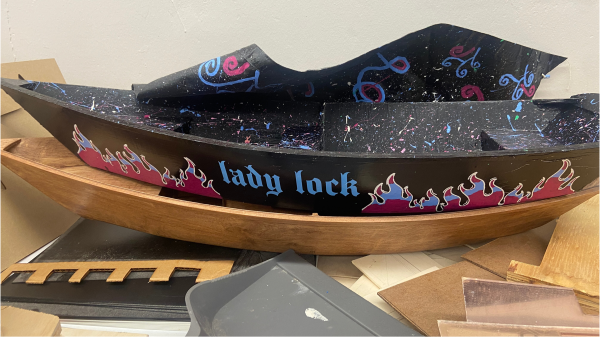
I also visited a public school that maintains partnerships with the NASA Center at the ninth-grade level and with the Navy and the Air Force in high school. Students engage in robotics, drone piloting, applied engineering, and project-based learning connected to real-world challenges. One of the most symbolic learning experiences involves boat building: students first construct individual boats and later collaborate to build a larger one, which they test on the Great Lakes. This kind of hands-on learning integrates risk, error, calculation, collaboration, and purpose, learning that feels real because it is real.
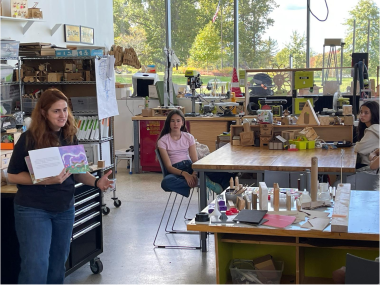
At Hawken School, the impact was equally profound. Student autonomy is tangible. Watching high school girls confidently and responsibly operate circular saws led me to reflect on how autonomy is built through culture, expectations, and trust. Nothing there is improvised, but nothing is rigid either.
One of the most enduring reflections from this journey came from observing how educators are regarded across these spaces. Even in highly innovative environments, respect for teachers is non-negotiable. Discipline, attentive listening, and recognition of the educator’s role coexist with creativity and freedom. This observation has stayed with me, especially
when considering the Brazilian context and the challenges we face in rebuilding school culture in the post-pandemic landscape.
By the end of this journey, one insight became clear: educational innovation does not begin with machines. It begins with culture. With how much we trust children and young people. With the autonomy we allow. With the respect we cultivate. With the intention we place into every learning environment.
More than visiting places, this fellowship was about living with people, exchanging ideas, and understanding that education, technology, and culture are inseparable. The experience has directly influenced how I design programs, lead Fab Lab initiatives, and think about the role of technology in learning,
not as a showcase, but as a tool for agency, care, and meaning.
I returned changed, with more questions than answers. And for me, that is always a good sign.
If I could leave one invitation, it would be this: apply, participate, and occupy these spaces. The world needs more educators crossing borders, building connections, and bringing these experiences back to their communities. It is deeply worth it.