The World Comes Back to Me – SCOPES-DF

Lesson Details

Age Ranges *
Author

Author

Amany Ayman
Amany Ayman
Informal educator
I am a dedicated STEM education specialist in Fab Lab Egypt, with a passion for delivering innovative and engaging learning experiences. As a certified Fab Academy graduate, I have a strong foundation in digital fabrication, CAD design, electronics, and programming.… Read More

Summary

The World Comes Back to Me is a global citizenship lesson through systems thinking and STEM


Grade: Grade 8–9

Duration: 120–150 minutes

Subjects: Global Citizenship, STEM, Environmental Education, Social Studies

Technology: micro:bit, MakeCode

Key Concepts: Interdependence, Global Citizenship, Systems Thinking, Responsibility, Solidarity, Sustainable Development


Summary:

Students explore how their everyday lives are connected to people, places and systems around the world. They begin by tracing the hidden journey of an everyday product and discover the many people, resources and countries involved in bringing it to them.

They then investigate different “What If?” scenarios to see how an event in one place can create effects in distant parts of the world. Students make these invisible connections visible through a large world map.

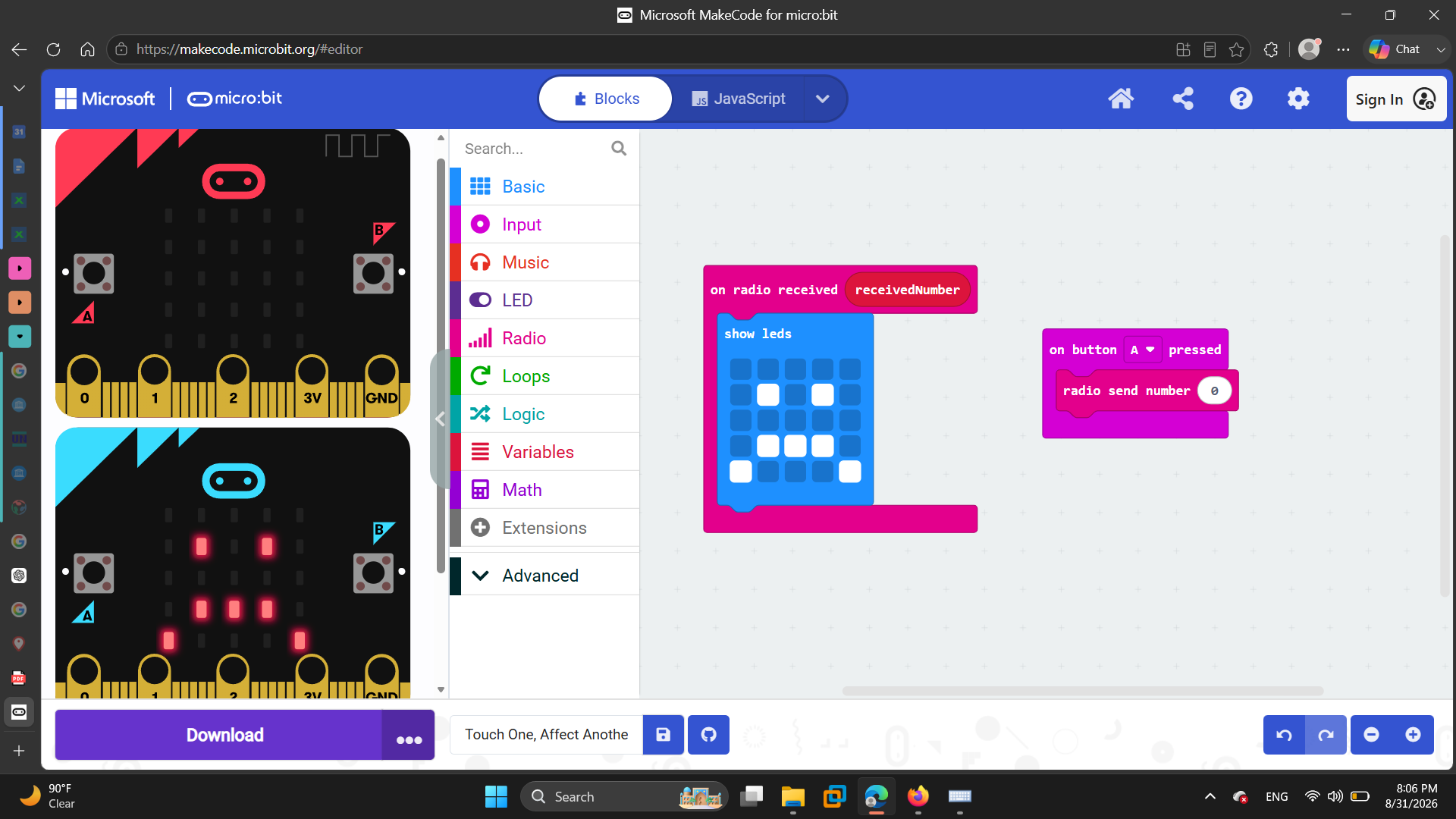
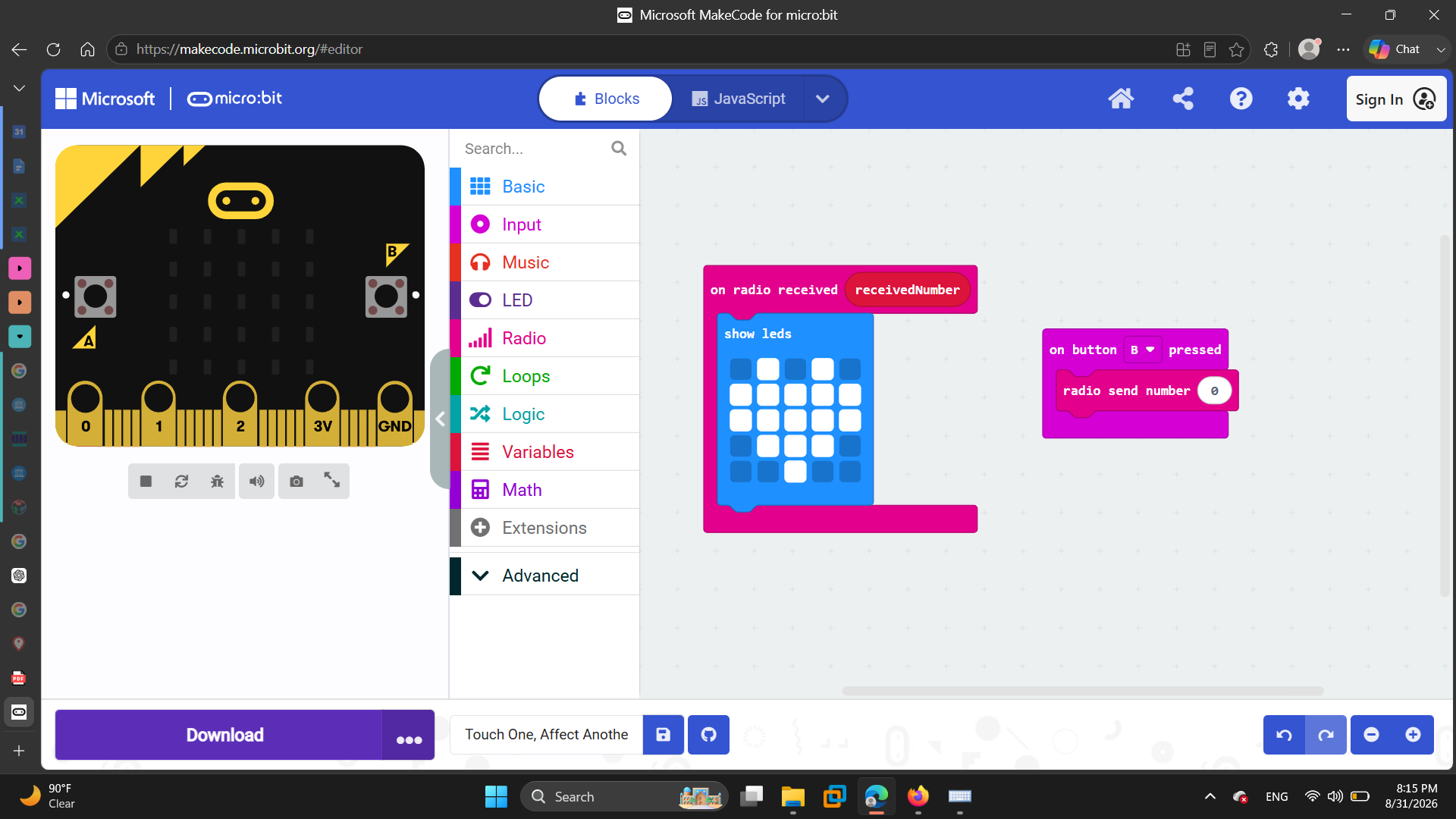
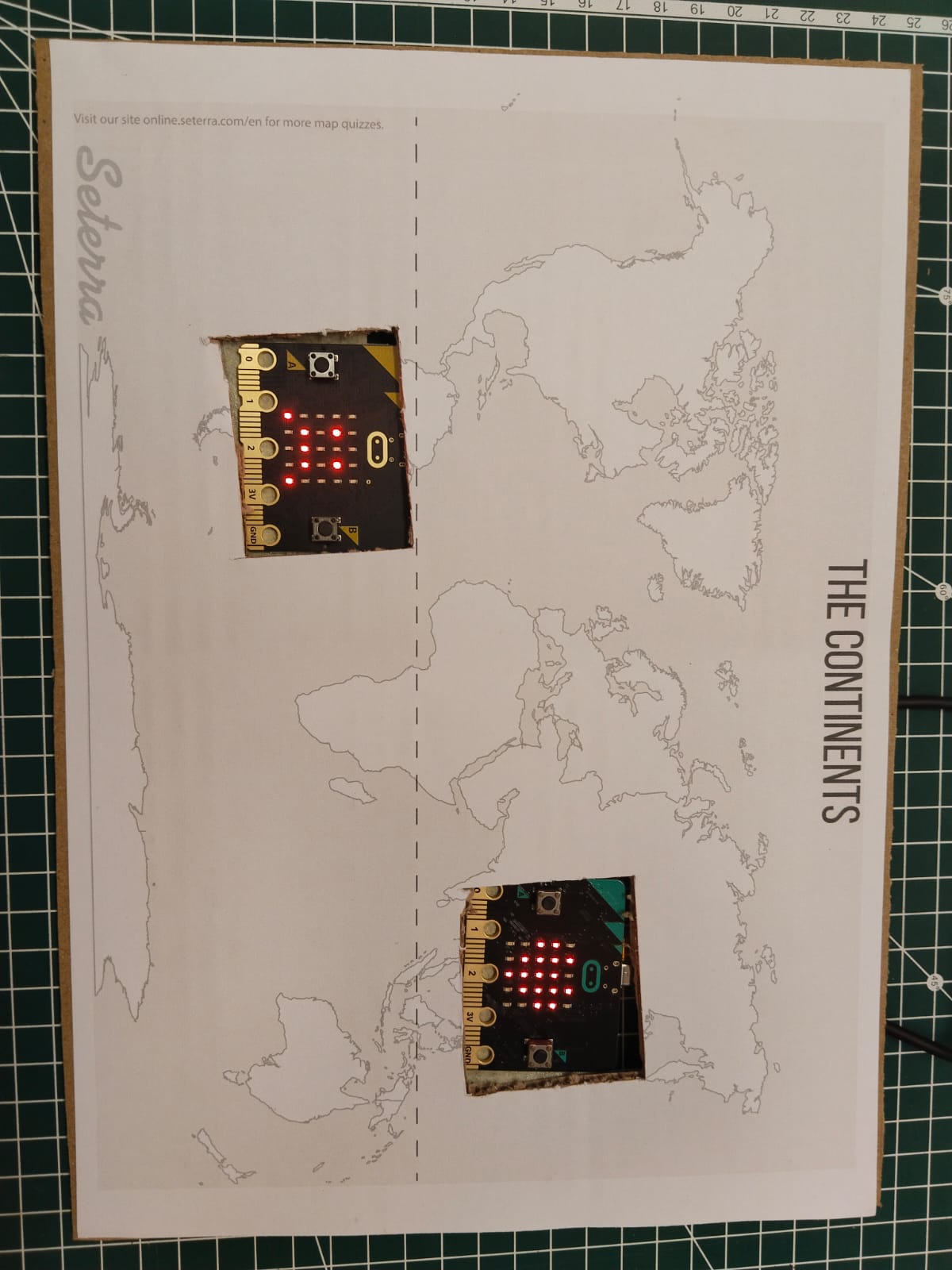
In the STEM activity “Touch One, Affect Another,” students use two micro:bit and radio communication to model these connections. A button pressed at one location sends a message to another location, causing the second micro:bit to display a sad face. Later, the same system is changed so that an act of solidarity sends a heart instead, highlighting that connections can spread not only harm, but also care and support.

Finally, students return from the global scale to themselves and identify how their own choices and initiatives can contribute to positive change. They create a My Global Citizen Action Card and are encouraged to think not only about what they can do, but how far one action could travel when others join it.
What You'll Need

General Materials

  • The world map printed
  • Cardboard
  • Sticky notes
  • Markers
  • String/yarn or arrows for showing connections
  • Scenario cards
  • Everyday product cards or examples
  • Student notebooks

STEM Activity “for each group”

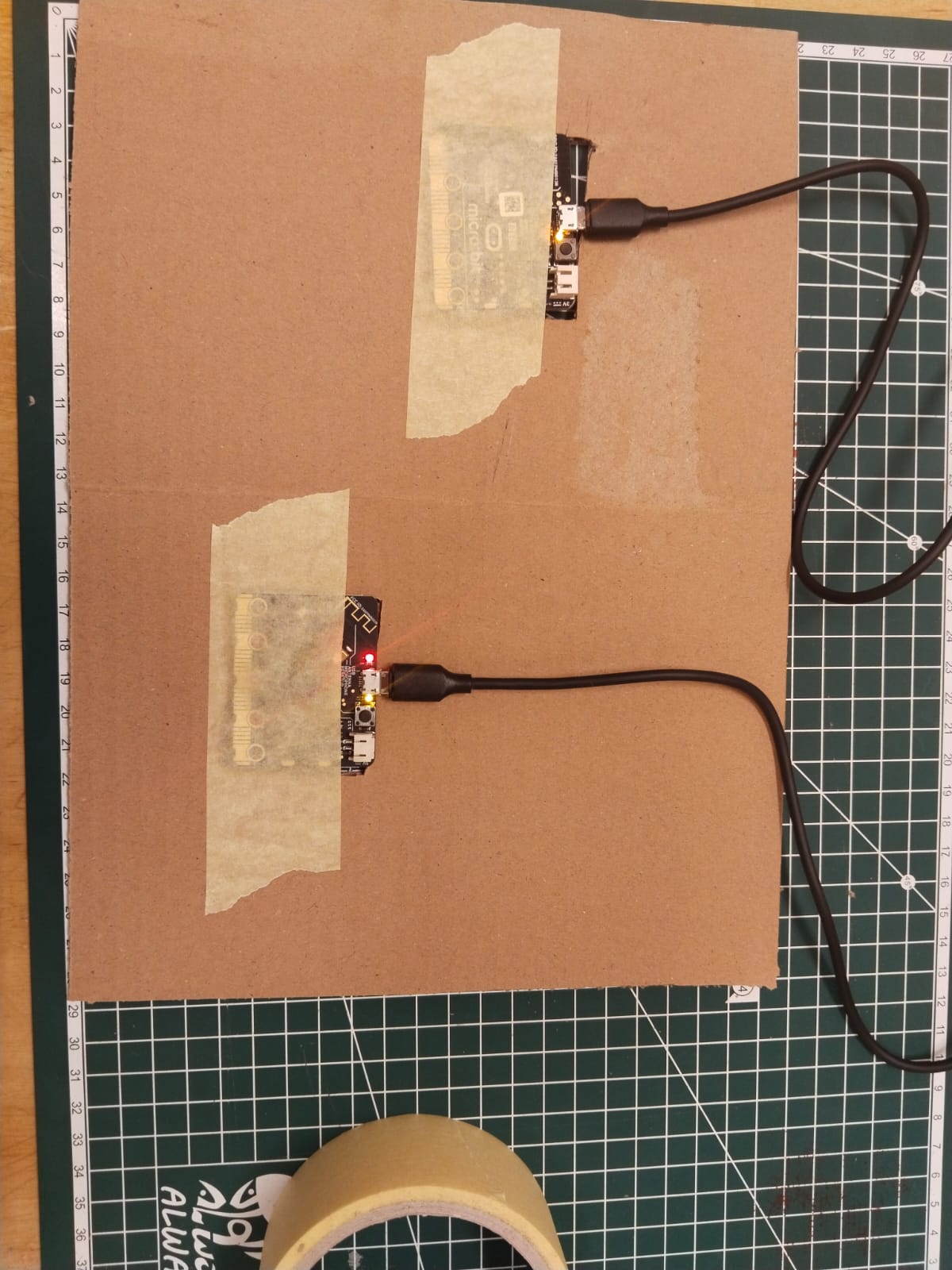
  • 2 micro:bits
  • 2 battery packs
  • 2 USB cables
  • Computers/tablets with MakeCode
  • Student starter code
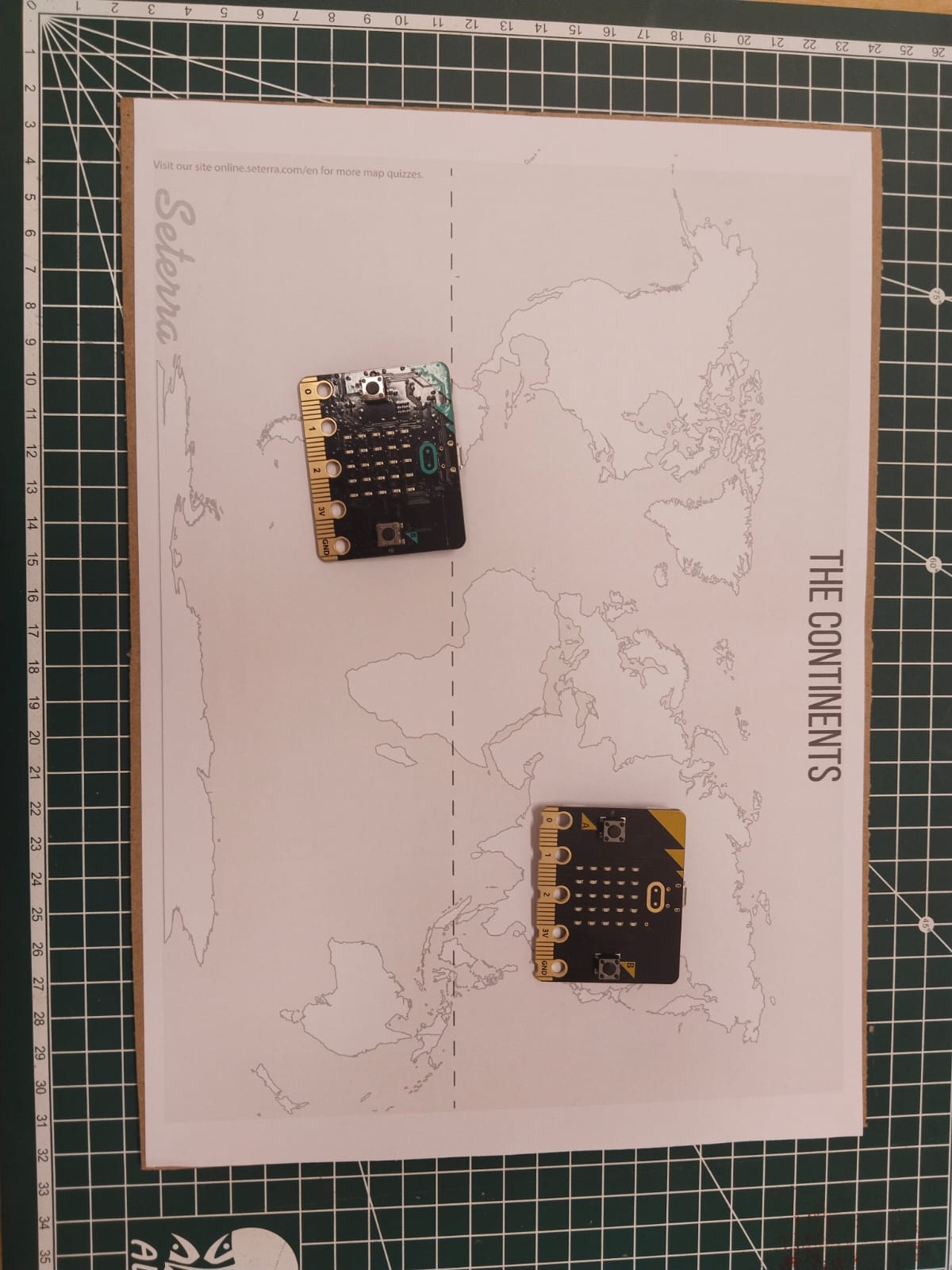
  • Cardboard with printed world map


Learning Objectives

After this lesson, students will be able to:

  1. Identify connections between people, places, resources, and systems across the world.
  2. Explain how an event or decision in one location can create social, environmental, or economic effects somewhere else.
  3. Model a cause-and-effect relationship between different locations using micro:bit radio communication.
  4. Identify possible intervention points where different choices or actions could reduce harm or create a better outcome.
  5. Recognize their responsibility and agency as members of an interconnected global community.
  6. Propose an action they can take individually or with others and explain how it could create impact beyond themselves.


Reflection

This lesson plan brings students back to the central question: If the world is connected, what responsibility comes with that connection?


  • Students reflect on four key takeaways:
  • The world is connected: Our lives depend on people, places and systems beyond our immediate surroundings.
  • I am part of that connection: My choices are part of a larger system.
  • My choices affect others: Our actions can create consequences, even when we cannot immediately see them.
  • My actions can inspire change: One person can start an action that grows through others and reaches far beyond their community.


  • Students then complete their My Global Citizen Action Card, moving from understanding global challenges to identifying an action they can take and imagining how it could grow through collective action.


Global Citizenship Connections: This lesson develops key Global Citizenship Education themes


  • Interconnectedness • Global and local responsibility • Empathy • Solidarity • Peace and cooperation • Sustainable development • Systems thinking • Critical thinking • Participation • Agency • Action for change


The lesson connects these ideas through the progression: Discover → Connect → Understand consequences → Take responsibility → Act

The Instructions

Activity 1 – Where Did This Come From?

Discovering Our Hidden Connections: Here, students will think and discover the connections between everyday products they use and different countries across the world! Suggested time: 25–30 minutes

1- Introduce the challenge: Show students an everyday object such as a smartphone, T-shirt, chocolate, packaged food or water bottle.

  1. Ask: “How many people and places do you think are connected to this object before it reaches you?” and do not give the answer yet.


2- Tracing the product: Divide students into small groups.

  1. Give each group one product and ask them to investigate or use prepared information cards to identify:
  • Where its raw materials come from
  • Where materials are processed
  • Where components/products are made
  • How they are transported
  • Who works at different stages
  • Where the final product is used
  1. Students create a simple connection chain: Resource → People → Country → Factory/Process → Transport → Shop → Me

3- Build the global picture

  1. Ask groups to place their connections on the large world map.
  2. Use arrows or string to connect the different locations.

4. Discuss

  • Ask:
  • “How many people involved in this product will you probably never meet?”
  • “Would changing something in one part of this journey affect other parts?”
  • “Are we really as separate from people in other countries as we sometimes think?”
  • Allow students to share their observations.

5. Expand the idea

  • Explain that products are only one example.
  • Our world is also connected through:
  • water and rivers
  • air and climate
  • food
  • energy
  • trade
  • technology
  • migration
  • communication
  • health
  • conflict and peace


6- Introduce the key idea: The world is made of connected systems. What happens in one part can affect another.

Activity 2 – What If?

Seeing the Ripple Effect: In this Activity, we will ask puzzling questions: What if a part of the chain is missing? How will it affect the others? Suggested time: 25–30 minutes

1. Introduce the game

  • Tell students: We have seen how things are connected. Now let’s imagine that something suddenly changes in one part of the world. What happens next?
  • Give each group a scenario card.


— Example Scenario Cards

  • The Amazon Rainforest
  1. Large areas of rainforest are destroyed.
  2. What could happen next?
  • A Shared River
  • A dam changes the flow of a major river shared by several countries.
  • What could happen downstream?
  • A Global Disease Outbreak
  • A new disease causes lockdowns and factories and transportation systems stop operating.
  • What might happen in other countries?
  • A War
  • A conflict begins between two countries.
  • How could it affect people, education, research, the environment, food or neighbouring countries?
  • Antarctic Ice
  • A major increase in Antarctic ice melting occurs.
  • What systems and communities could eventually be affected?


2. Build the chain

  1. Ask groups to create a chain of effects:
  2. Event → First Effect → Second Effect → Third Effect → Distant Effect
  3. Encourage them to think beyond geography. For example:
  4. Factory closes → workers lose income → products become less available → prices change → consumers elsewhere are affected


3. Add the connections to the map

  1. Groups place their event and effects on the world map.
  2. Use different coloured arrows or strings to show how the effect travels.


4. Challenge the students

  • Ask:
  • “Where did the effect start?”
  • “Where did it end?”
  • “Was the final place directly responsible for the original event?”
  • “Could someone somewhere along the chain have acted differently?”


5- Introduce the idea: In an interconnected system, there may be many places where a different decision can change what happens next.


Activity 3 – Touch One, Affect Another

Activity Core Idea is: Modeling Global Interdependence with micro:bit Micro:bit is a beginner-friendly smart board that has a microcontroller and built-in sensors and actuators. We will build code through block programming, via the MakeCode platform. The code is simple and connected to the past activity: If something happens, another thing is initiated Suggested time: 35–45 minutes

1. Introduce the challenge

  • Show students the two micro:bits
  • Tell them: “We know that one event can affect a place far away. Can we build a system that makes that invisible connection visible?”
  • Explain that the micro:bit will communicate using radio.


2. Build the basic communication

  • The teacher will explain the simple “if Condition” block
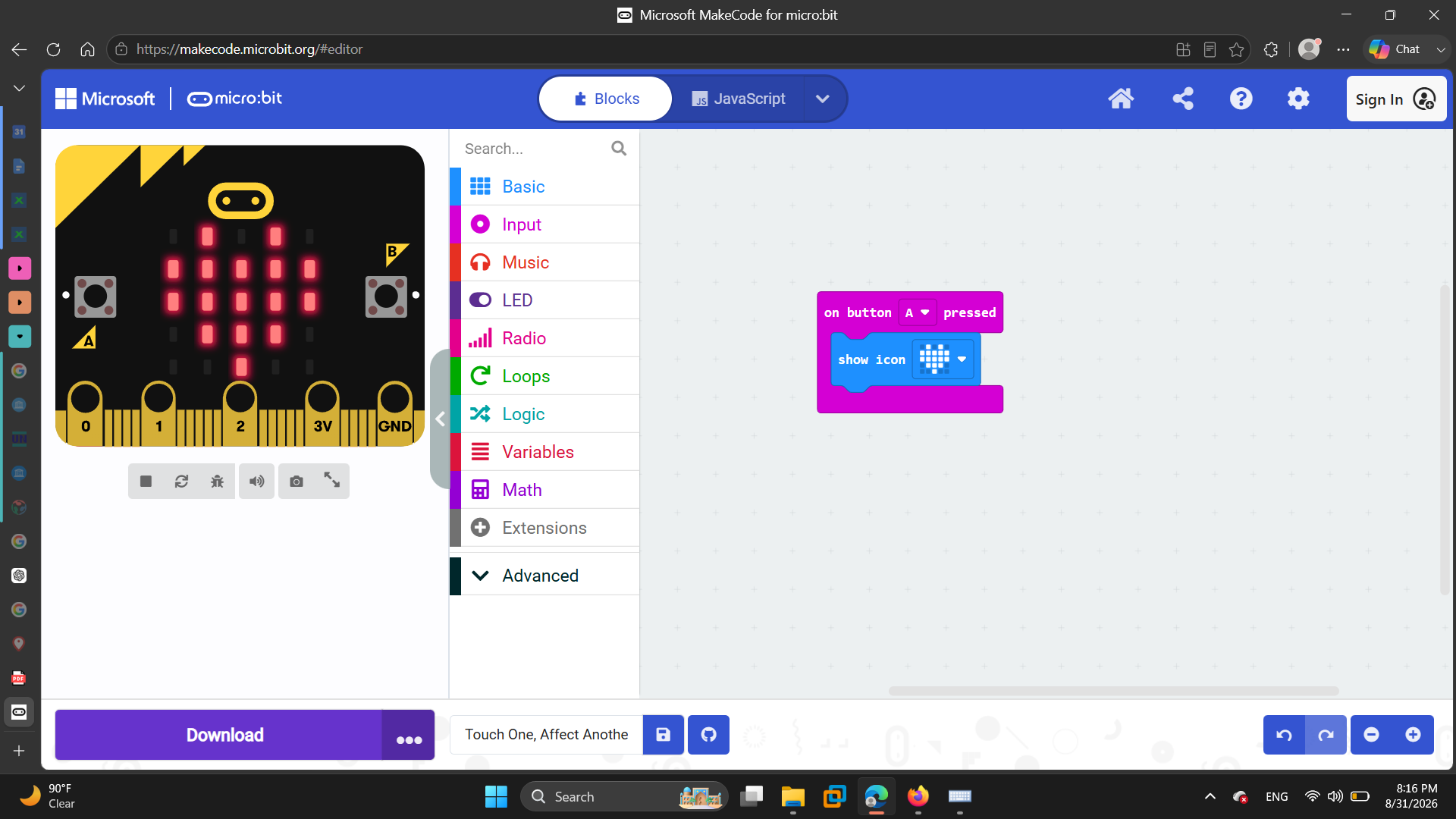
  • If Button A is pressed: show an icon
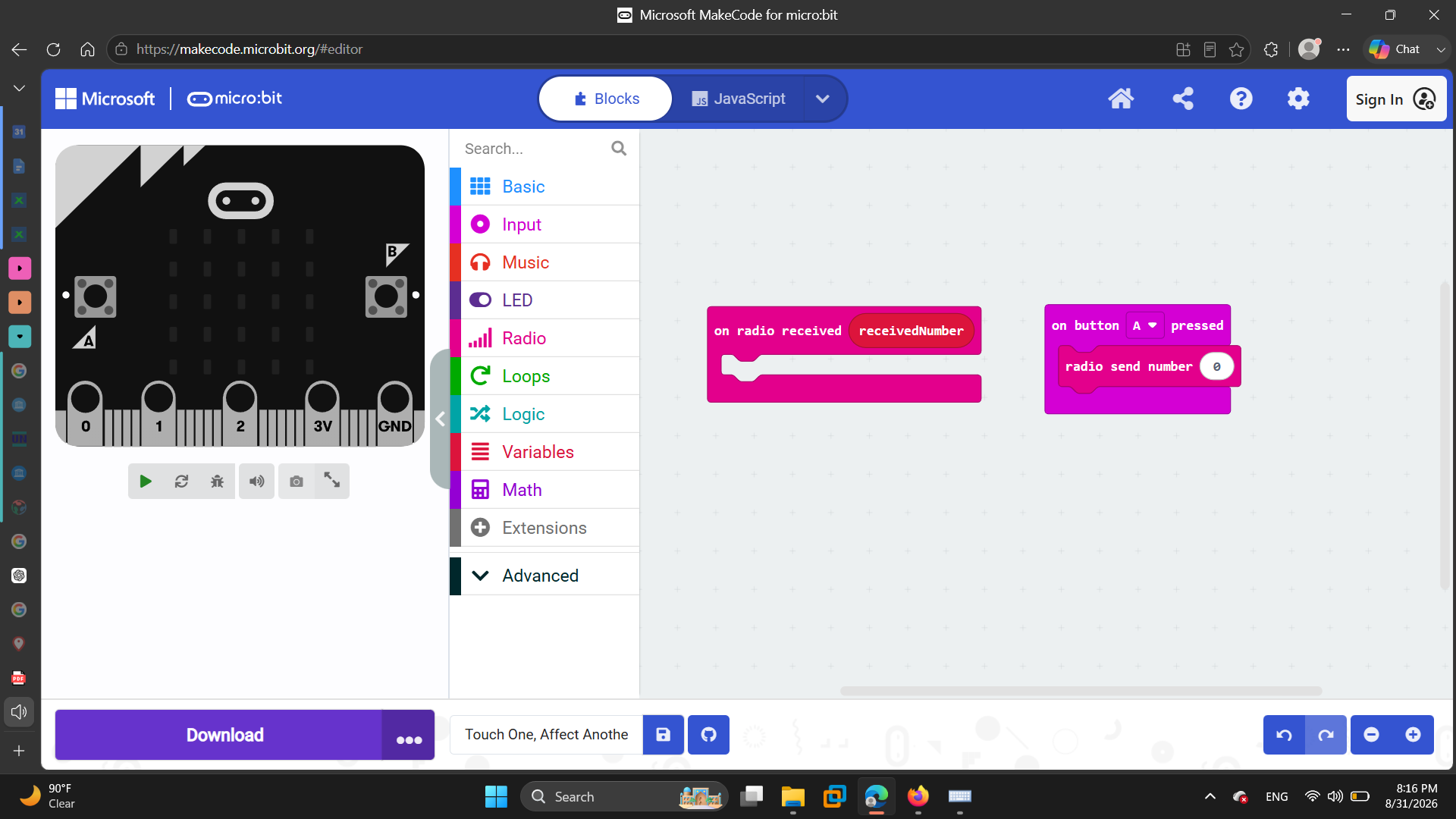
  • Then explain the radio blocks: if the button is pressed, send a message
  • One micro:bit acts as the sender and the other as the receiver.
  • When a button is pressed on the sender, a radio message is sent.
  • The receiver responds to the message.
  • Then, students build a simple radio program.


3. Put the micro:bit on the map

  • Place the sender at one location on the cardboard world map and the receiver at another location.
  • For example:
  • Amazon → another part of the world
  • or Country experiencing conflict → neighbouring/distant country


4. Connect it to the scenario

  • Students choose one of the scenarios from Activity 2.
  • They decide:
  • What happens in the first location?
  • Which distant location is affected?
  • What message should be sent?

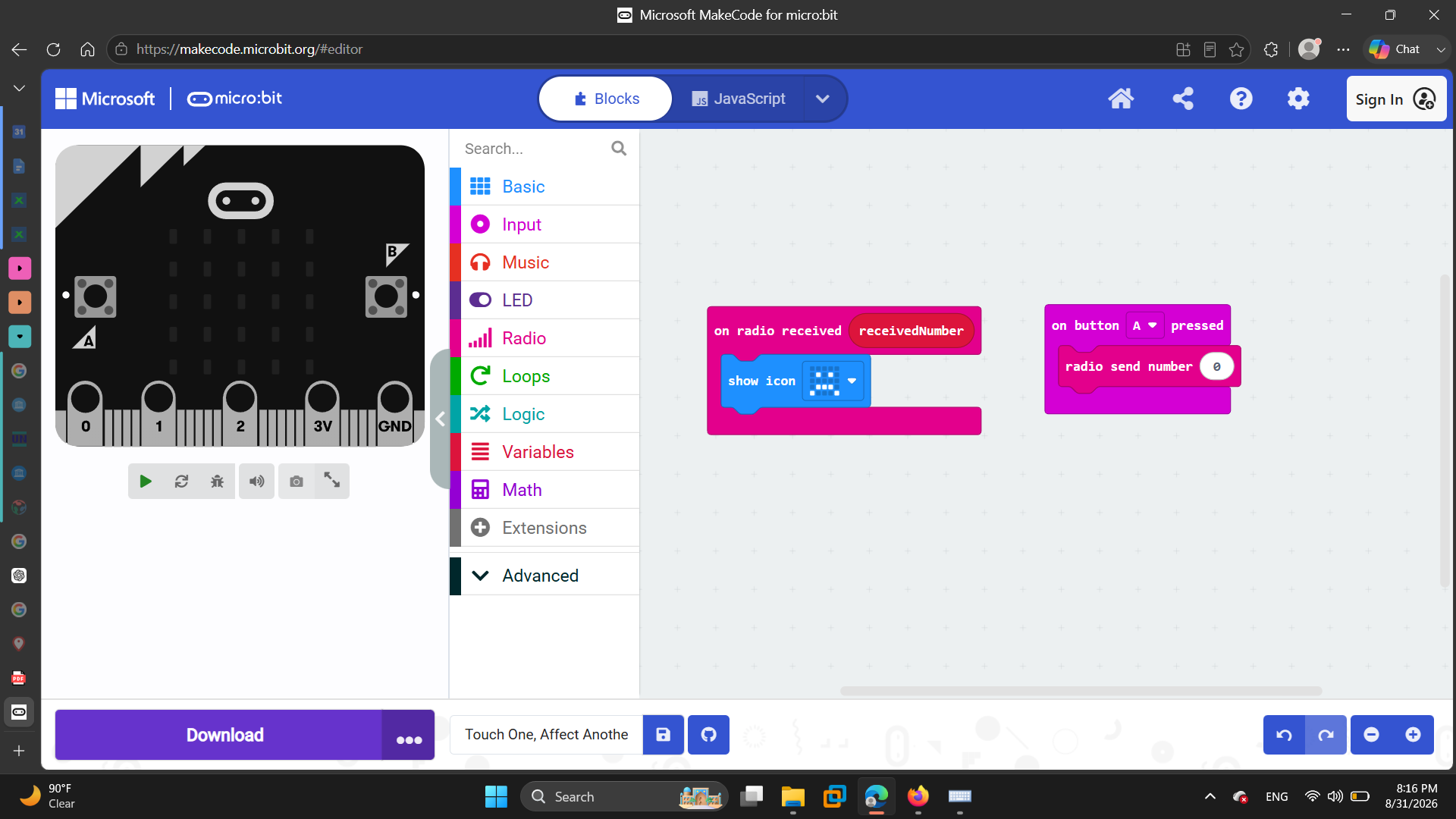
5. Program the crisis response

  • Program the sender so that pressing the button represents the event.
  • For example:
  • Button pressed → “Crisis” message sent → Receiver displays a sad face
  • Students test the system.
  • Pause and ask:
  • “What just happened?”
  • “Did anything physically move from one country to the other?”
  • “So what does the micro:bit radio wave represent?”
  • Guide students toward: It represents an invisible connection between two places.

6. Find an intervention point

  • Ask: “What could have been done differently?”
  • Students identify one possible action that could reduce the harm in their chosen scenario.
  • This could be:
  • cooperation
  • early intervention
  • sustainable environmental decisions
  • reducing waste or consumption
  • humanitarian support
  • sharing information
  • peaceful negotiation
  • protecting natural resources

7. Edit the Code & Add solidarity

  • Now modify the system.
  • Explain: “We have seen how harm can travel through connected systems. But can care travel too?”
  • Add a second message to the program representing solidarity.
  • When the “solidarity” button is pressed, the receiving micro displays a heart instead of a sad face.
  • Students test both:
  • Crisis → Sad Face
  • Solidarity → Heart


8. Discuss

  • Ask:
  • “What changed?”
  • “Can an action in one place create a positive effect somewhere else?”
  • “What does the heart represent?”


9. Introduce the key idea: Connection does not only allow problems to spread. It also allows people to support one another and create change together.


Activity 4 – The World Comes Back to Me

From Global Awareness to Personal Agency: After seeing the world, let's return to ourselves and our role in the world! Suggested time: 25–30 minutes

1. Zoom out

  • Show the students the map and ask them to think about the journey of the lesson.
  • Start with: ME
  • Then expand: ME → MY COMMUNITY → MY COUNTRY → MY CONTINENT → THE WORLD
  • Ask: “Where are you in this system?”

2. Connect global issues to everyday choices

  • Give students everyday situations:
  • Buying something we do not really need
  • Throwing rubbish away carelessly
  • Wasting food or water
  • Sharing information without checking it
  • Ignoring environmental problems
  • Hearing about a crisis in another country
  • Seeing discrimination or exclusion
  • Choosing to support or ignore a community initiative
  • Ask:
  • “Does this choice affect anyone beyond me?”
  • “Where could the effect travel?”
  • “What is within my control?”

3. Introduce a real child-led initiative

  • Share a short, verified story of a child or young person who started a community initiative that eventually reached a much larger number of people.
  • For example: Alexandra Scott and her lemonade stand fundraising to find cures for all children battling cancer
  • Focus on the beginning: “It started with one person.”
  • Ask: “Did this child solve the whole problem alone?”
  • Then reveal the important part: “One action can inspire another person. That person can involve another. A small initiative can become a community movement and reach places the original person never imagined.”

4. Connect back to the micro:bit

  • Remind students: “At the beginning, pressing one button caused another place to respond.”
  • Ask: “Could our actions work in the same way?”
  • Students discuss examples: One person acts → another joins → a group forms → a community responds → the idea travels


Activity 5 - My Global Citizen Action Card & Lesson Wrap Up

Now, each student will fill "MY GLOBAL CITIZEN ACTION CARD" Suggested time: 10–15 minutes

1- Give each student an action card, or make students write in their notebooks the following:

  • My Reflections:
  • I now understand that…
  • One connection I had never noticed before is…
  • One issue I care about is…
  • One action I can start is…
  • I could do it with…
  • If other people joined me, this could become…


  • DREAM BIG
  • If my action reached 100 people…
  • If it reached 1,000 people…
  • If it travelled beyond my community…


  • My Global Citizen Promise
  • Because we are connected, I will…


2- Lesson Summary: At the end of the lesson, bring students back to the central question: If the world is connected, what responsibility comes with that connection?

  • Summarize the journey:
  • We discovered connections: Our everyday products connect us to people and places around the world.
  • We explored consequences: An event in one place can affect distant people, environments and systems.
  • We made the invisible visible: The micro:bit showed how one action can trigger a response somewhere else.
  • We explored alternatives: Different decisions can sometimes change what happens next.
  • We came back to ourselves: We are not outside the system. We are part of it.
  • And because we are part of it: Our choices matter.
  • But our responsibility is not to solve every problem in the world alone.
  • It is to recognize where we have influence, act responsibly, work with others, and understand that our actions can travel further than we can see.


Lesson Feedback

Contact us

Having trouble? Let us know by completing the form below. We'll do our best to get your issues resolved quickly.

"*" indicates required fields

This field is for validation purposes and should be left unchanged.
Name*
Email*
?