- Loading…


The lesson is about learning to see music (and the creation of music) as a set of intervals rather than a set of static “notes”.It’s about understanding the fundamentals that make music work. Rather than following a written script. We follow a basic formula which helps understand both how music works and how it is reflected in an instrument like the guitar.
Students will learn the fundamentals of interval principle in music through singular notes that build up chords, which can be arranged in a progression that sets up the “story” of a song. Like for example in Blues.
Where it differs from our classical understanding of music, is that this encourages you to experiment with theory, and only using musical data that is relevant to you instead of needing a deep understanding or script first.
Instrument Guitar tuned in EADGBE (standard)
Tuner Tuner A=440hz
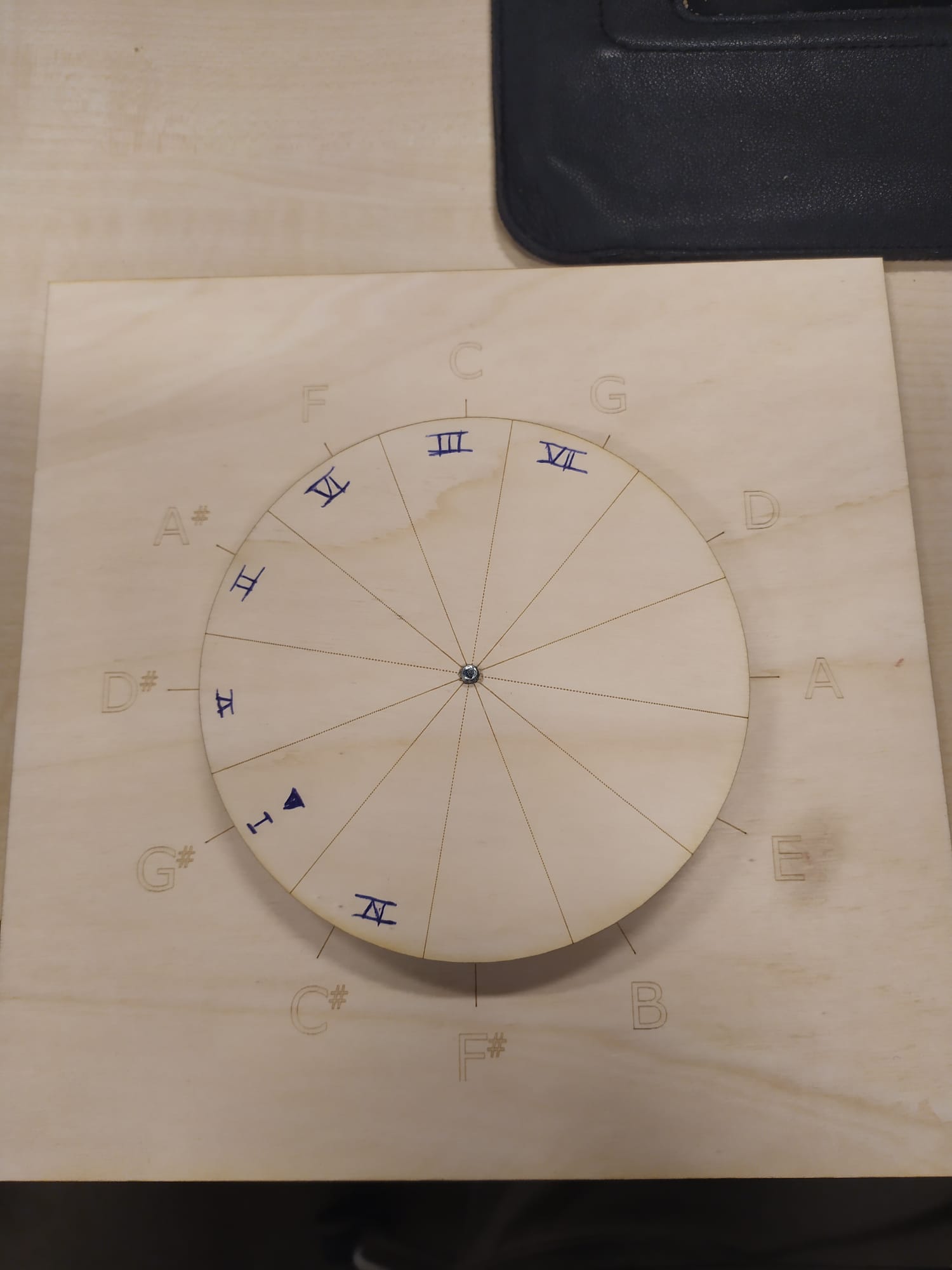
Chordwheel
Whiteboard to write the intervals
Additional resources
Book of chord grips with schematics to play them on the guitar. Specifically: all the “open” chords:
Major: C A G E D
Student understand a musical scale as intervals relative to a root (note).
Students can order intervals within a musical scale into a hierarchy
Students can apply this hierarchy to construct chords. .
Students can use constructed chords into a sequence to make a chord progression
Nv.t
Explain how a "western" musical major scale is built up. With a guitar. If students brought own guitar they can play along.
Starting example E major on guitar.
Every fret on a guitar is called a step. Some intervals have 2 steps, others have 3.
The string of intervals between notes is always the same. Which we call, for example major or minor.
There are important, and less important intercals relative to the root, that we should consider and remember.
Hierarchy of Intervals for western major scale.
Root (tonic)
The Fitfh
The third (major or minor)
The seventh
The fourth
We just leard to apply this hierarcy to our intervals in our scale. Now we use that hierarcy to play these notes silmultanisly to create a chord.
Using our hierarchy of Intervals for western major scale.
Lets plat the first three intervals in the hierarchy silmultaniously:
Root (tonic)
The Fitfh
The third (major or minor)
The seventh
The fourth
To test our hierarcy we could add one more layer, the seventh. Does that sound right?
How about removing The Third and the Seventh?
Making multiple chords into a string, creates a progression. This is what makes up the genre of the song. Like with a story: A romantic stoty, or a horror. The same way the type of progression influences its genre
Apply the same principle that constructed the chord. But now use it to determine the chord you want to play.
Make 3 major chords out of the following scale intervals:
the Root I
the fourth IV
the Fitfh V
Now play in a 4/4 measure. Meaniny every chord numeral lasting 4 counts.
I – IV – I – V
Having trouble? Let us know by completing the form below. We'll do our best to get your issues resolved quickly.
"*" indicates required fields