
- Loading…

The “Design Your Own Tiny House” activity is part of the FabConnectHer project, which helps young women learn skills in science, technology, engineering, art, and maths (STEAM). In this lesson, students explore the concept of Tiny Houses as a creative and sustainable solution to housing shortages. They work individually or in small groups to research, calculate, and design their own Tiny House.
The activity combines mathematics and science with creativity and design. Students practise calculating scale, area, circumference, and surface, and use these skills to make cost estimates. They then turn their ideas into layouts using digital tools like Floorplanner and paper sketches, before building a 3D cardboard model of their house. Some elements can even be 3D printed to add furniture and details.
This lesson is suitable for middle school, high school, and college students. It builds confidence in teamwork, problem-solving, and practical modelling while connecting learning to real-life issues such as sustainability and housing. By the end, students will have designed and built their own scale model Tiny House, combining technical skills with creativity to imagine solutions for the future.
Materials:
Mathematics
Science and Technology
General Skills
This activity gives students the chance to connect maths and science with real-world problems in a creative way. By designing and building their own Tiny House, they learn how to use scale, area, and circumference in a practical project and see how these skills apply outside the classroom. The process also helps them understand housing shortages and think about sustainable solutions for the future.
Working with cardboard, digital tools, and even 3D printing builds students’ confidence in handling different materials and technologies. They also develop teamwork and problem-solving skills as they make decisions about layouts, costs, and design choices. In the end, students not only create their own 3D model but also experience how creativity, mathematics, and science can come together to design something meaningful and useful.
Students are introduced to the concept of Tiny Houses, learn why they are being used to address housing shortages, and explore their benefits for the environment and society.
Tiny houses are currently the solution to quickly place homes somewhere. Too few houses have been built in the Netherlands in recent years. At the same time, environmental requirements have become stricter and make it increasingly difficult to build quickly. Think of nitrogen problems and the protective measures for all kinds of plants and animals. Municipalities in the Netherlands are increasingly switching to the installation of temporary container homes to meet the need for more living space.
Tiny houses are small houses that have between 15 m2 and 50 m2 of living space, where you can live in. The houses are often made from shipping containers. These are relatively inexpensive to purchase and easy to stack. A container can easily be converted into a home in a large factory.
The construction time of a Tiny house is very short. The energy and water consumption are lower than ordinary homes and the homes take up much less space.
All this contributes to a better environment and solves part of the housing shortage.
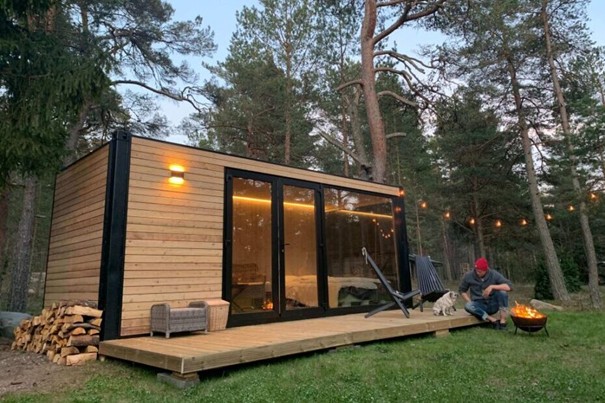
Students research Tiny Houses online and answer questions about their definition, purpose, use of containers, dimensions, and advantages to understand their role as a housing solution.
You are now going to do research on the internet about Tiny Houses.
Answer the following questions:
Students calculate the surface area of a wall in their Tiny House model, practising how to use formulas and convert measurements into square meters.
Below you can see a long inner wall of your Tiny house. In connection with paint that must be applied to this wall, we want to know how large the surface is.
 Calculate the area A of this wall in m2. (write down your calculation)
First, write down the word formula for this calculation.
Please note that all sizes given are in cm.
Students calculate the surface area of the back wall of their Tiny House, subtracting the window space to find the correct area in square meters.
You can see the back of your Tiny house above. In connection with paint that has to be applied to this wall, we want to know how large the surface is.
You don’t have to paint where the window is.

Calculate the area B of this wall in m2. (write down your calculation)
First, write down the word formula for this calculation.
Please note that all sizes given are in cm.
Students calculate the surface area of the front wall of their Tiny House, subtracting the door space to find the total area in square meters.
You can see the front of your Tiny house on the right. In connection with the paint that has to be put on this wall, we want to know how large the surface of this wall is. You don’t have to paint where the door is.

Calculate the area of this wall in m2. (write down your calculation)
First, write down the word formula for this calculation. Please note that all sizes given are in cm._
Students calculate the areas of circular shapes on the ceiling of their Tiny House, using the correct formulas and converting the results into square meters.
You can see the ceiling of a Tiny house below. A resident wants to apply these round figures to the ceiling.

Calculate the area of figure G in m2. (write down your calculation)
First, write down the word formula for this calculation.
Please note that all sizes given are in cm.
Calculate the area of figure H (previous page) in m2. (write down your calculation)
First, write down the word formula for this calculation.
Please note that all sizes given are in cm.
Students calculate the areas of different floor sections (D, E, and F) of their Tiny House, then work out the circumferences of selected parts, practising accurate use of formulas and unit conversions.
You can see the floor of your Tiny house below. This floor is covered with different types of floor covering.

Calculate the area E of this part of the floor in m2 (write down your calculation). First, write down the word formula for this calculation.
Please note that all sizes given are in cm.
You can see the floor of your Tiny house above. This floor is covered with different types of floor covering. Calculate the area D and F of this part of the floor in m2 (write down your calculation). First, write down the word formula for this calculation. Please note that all sizes given are in cm.
Now calculate the circumference of figures D and E in meters. (write down your calculation) Please note: all given sizes are in cm.
Outline figure D :
Circumference figure E :
Students use their surface area calculations to research and create a cost overview, finding the right quantities of paint and flooring online and adding up the total cost.
On the previous pages you have calculated the surfaces of the walls and the floor. You will need this to calculate how much paint and carpeting you need. Go to a hardware store on the internet and find the materials you need in the right quantities.
Material type:
Surface in m2:
Rounded quantity:
Cost in euro’s:
Material type:
Surface in m2:
Rounded quantity:
Cost in euro’s:
Material type:
Surface in m2:
Rounded quantity:
Cost in euro’s:
Total:
*copy rows if needed.
Students convert the real dimensions of a container home into centimeters, calculate the scaled measurements for different ratios, and draw the container shapes on grid paper to prepare for building their 3D model.
We are now going to start making a 3D model. The dimensions of the sea containers that have been used as temporary homes in some cities have a size of 6m x 2.5m x 2.5m (lxwxh).
Convert these dimensions to centimeters.
We are now going to start making a 3D model. Below you can see a picture of your temporary home. In technology, predetermined scales are used.
Here you can see your home on a scale of 1:100, 1:50, 1:25 and 1:20

You are now going to calculate how big your model will be in cm if we are going to use one of these scales for your model.
Fill in the open spaces and do the math:
Dimensions in real life: 600x250x250
Scale: 1:100
Scale factor: 0,01
My scale model will then be: 600×0.01=6cm, 250×0.01=2.5cm
Dimensions in real life: 600x250x250
Scale: 1:50
Scale factor: …………………
My scale model will then be: …………………….
Dimensions in real life: 600x250x250
Scale: 1:25
Scale factor: …………………
My scale model will then be: …………………….
Dimensions in real life: 600x250x250
Scale: 1:20
Scale factor: …………………
My scale model will then be: …………………….
Ask your teacher for an A3 sheet with squares. Now draw the 4 rectangular shapes of the 600×250 container on the 4 different scales. Please use the table above
Students use an online tool like Floorplanner to create a digital layout of their Tiny House, including required amenities, and review their design with the teacher for approval.
Before you start making a drawing to scale, you will use an online free program to make a layout of your Tiny house. You can do this on the website www.floorplanner.com. With this program you can make a quick layout of your Tiny house very quickly and precisely. Sign up on this site and create a free account.

Your home should have a number of basic amenities.
The following items must be present:
Once you’re done, discuss your design with your teacher. They check whether the design is satisfactory.
Students prepare for their 3D model by making a scaled drawing of their Tiny House on A3 grid paper, using a 1:20 scale.
Make a design on paper.
In preparation for creating the 3D model, you will make a scale drawing of your design. You ask for an A3 paper layout with boxes from your teacher. Now draw your design on a scale of 1:20 on this A3 paper.
Students build a 3D scale model of their Tiny House using a cardboard kit, add furniture with 3D prints, and decorate surfaces with wallpaper, stickers, or fabrics.
Students present their finished Tiny House models, reflect on the process and challenges, then clean up and organise the workspace.
Review and Showcase (15 minutes)
Cleanup (10 minutes)
Having trouble? Let us know by completing the form below. We'll do our best to get your issues resolved quickly.
"*" indicates required fields